This is a paper I wrote for my clothing & society class that I figured I should upload here as I’ve been very inactive
The combat boot’s rugged construction and aesthetics of aggression have permeated many unassociated subcultures and were crucial in the formation of their infamy. From punks to biker gangs, these aesthetics gave these subcultures their initial mystique, permeating how we viewed and reported on these groups. These garments also affected how the subcultures viewed themselves, embodying these garments and their subculture. These two phenomena perpetuated each other; their actions and the frenzy around them erupted, largely due to the combat boot.
The first combat boot was made in 1816, called the Jefferson Boot. Like all boots at the time, the Jefferson Boot had no differentiation between the left and right boot and looked nothing like what we’d consider today as a combat boot, looking more akin to a chukka boot (Plocica). The modern idea of what a combat boot looks like comes from Corcoran’s Jump Boot, invented in 1941 for paratroopers in World War 2. These boots featured leather construction, elongated upper, metal eyelets, rounded toes, and slight heels that we’ve come to associate with combat boots. The boots were specially designed for paratroopers, with extra ankle support for rough parachute landings. These boots were unlike anything anyone had ever seen. Most soldiers fought with ankle boots wrapped with wool or canvas, so the calf-high full-leather boot became a signifier of acclaim within the US military since they were only given to the most extreme of soldiers, the paratroopers. Following World War 2, this combat boot style became the defacto style of boot issued for the US military, and eventually, the whole world followed suit.
Following World War 2, nearly half of the American draft-aged male population returned home. After their youth, friends, and innocence were stolen, many of these men had whiplash after being thrown back into society, a free shell of a man that the week prior was a state-owned killing machine. One of the biggest struggles for these young men was loneliness; they went from being surrounded by men their age, all with a common goal, to a world where no one could understand what they had just endured.
At the same time, the United States was auctioning off surplus bikes left from World War 2. Looking for something to use their GI money on, many veterans bought these discounted bikes to clear their heads. As more veterans got bikes, they began frequenting the same dive bars and creating smaller in-groups called motorcycle clubs or MCs, regaining their sense of community. In 1948, the Hells Angels were formed in San Bernardino, California, which would become the most infamous of these MCs. Though the founder of the Hell’s Angels is unknown, it’s often thought to be either Otto Friedli or George “The Bishop” Christie. In the coming decade, the Hell’s Angels would expand to have chapters in surrounding cities, eventually united under their first official leader, Ralph Hulbert “Sonny” Barger (Thompson). The national & even international coverage of the outrageous doings of these early MCs led to the tumourous growth of MCs of disgruntled youth worldwide, all wanting to be Brando-esque bad-boys.
Initially, these MC members used their leftover combat boots or surplus combat boots from WW2. Putting on these same boots they, just months prior, had worn to fight and kill for their country, they were once again soldiers, affecting the intensity of their actions and becoming protective of their new squadron. However, they would later switch to the engineer boot, which shared the same aggressive aesthetics and a very similar construction but was laceless, which was better for riding.
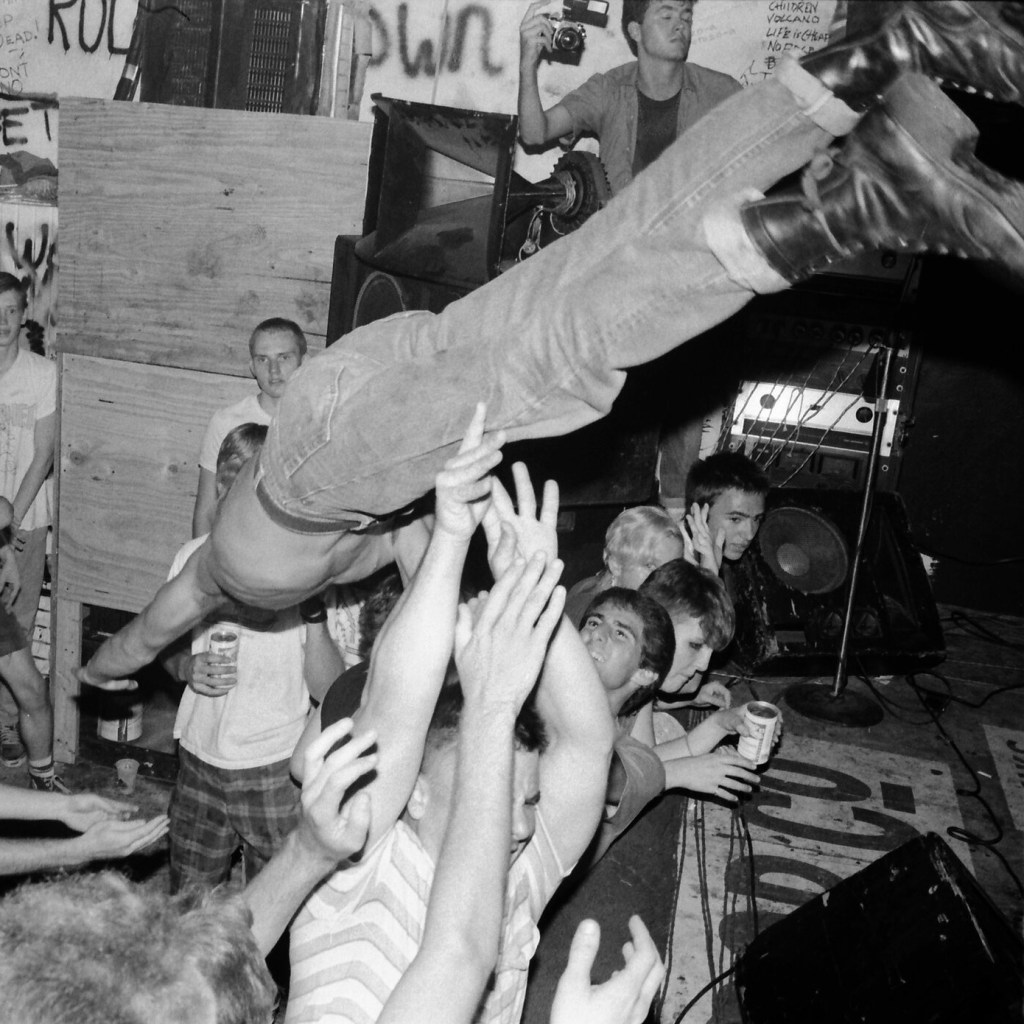
After the end of the Vietnam War in 1975, like after World War 2, military surplus stores and thrift stores were flooded with the issued garments that were left over. At the same what would become the punk movement was creating little bubbles in cities like Detroit, New York, and Los Angeles. Needing something to wear that would survive the chaotic, fast life that also matched the anti-consumeristic ideology of their music, punks turned to thrift & military surplus stores. The US punks gravitated to the mean-looking, dirt-cheap, and seemingly endless supply of Vietnam war combat boots; not only did they fit the lifestyle of the punks, but they also matched with the all-black, leather-jacked aesthetics set out by foundation bands like The Stooges and The Ramones. Paul Willis’ idea of homology explains this idea of the punk lifestyle and values of the punks matching their clothes (Hebdige 263). When studying hippies, Willis said that contrary to popular belief, these groups were not lawless but had extensive internal “laws,” especially regarding clothes. Clothes from these subcultures reflected their lifestyle, which reflected their music, which reflected their ideology, all intentionally matching to paint a cohesive picture. Across the pond, these aesthetics cues bands like The Sex Pistols, The Clash, and The Damned, and subsequently so did the London scene. This created a small problem, as Britain had very little involvement in the Vietnam War, so there was no surplus of combat boots for the punks to buy. This is where what could be considered the most popular punk boot of choice steps in Dr.Martens 1460. Mimicking a combat boot and marketed to the working class, these boots made for an excellent substitute in London’s scene.
As punk grew globally, these fashion ideologies and aesthetics stayed a part of the punk ethos. When speaking about his Autumn/Winter 2001 collection “Riot Riot Riot” and its heavy mixed use of militaristic and punk aesthetics, Raf Simons, a Belgian designer, said he was inspired by the Ukrainian and Romanian punks who’d buy military surplus clothing and subvert them with the classically punk tradition of DIY patches of political statements or their favorite bands, a continuation of the aesthetics of aggression (Sybil).
Though seemingly different, these two subcultures, bikers and punks, have more similarities than are visible on the surface. Both formed from a lack of meaning and disdain for authority, which in many cases resulted from feeling their youths being stolen against their will, forced to be a cog in “the machine.” These two groups wanted to stand against any authority, whether a boss, a cop, or an elected official. They also wanted to stand against the dominant consumerist culture that lay passive to everything they so despised. These groups developed their unique costume, symbolism, and dialects upon finding like-minded others, reflecting their ideology. Not only did this costume reflect their subculture, but it helped them to identify each other through “semiotic warfare” (Hebdige 259) and set themselves apart from those not in their subcultures. This also lead to them embodying their subculture. “I lived for my jeans, and as a result, I assumed the exterior behavior of one who wears jeans. In any case, I assumed a demeanor… As a rule, I am boisterous, I sprawl in a chair, I slump wherever I please, with no daim to elegance: my blue jeans checked these actions, made me more polite and mature” – Umberto Eco (Eco). When wearing an item of clothing, you consciously or not, take on the characteristics of what you associate that item with; this phenomenon is called embodiment. For both groups, their cultural costume came about through the fetishization of aggression that came with combat boots. When wearing these boots, members embodied a militaristic, aggressive attitude, embodying their subculture through their boots as part of their subcultural costume, emboldening their connection to their subculture and its ideologies.
Though these boots did not have anything aggressive about them, as they were just boots, the aggressive feeling they gave off was purely through a semiotic association to their inspiration, the combat boots worn in war. These boots, especially the rugged, angular “lug” sole, acted as indexical signs that implied the idea of war. Because in the case of Dr.Marten and the engineer boot, they were not the actual military-issued boot, they benefitted from the association to the boot associated with aggression while still being a blank enough canvas for them to subvert them to be associated solely with the subculture, recontextualizing what these boots meant (Hebdige 257). This semiotic association gives the wearers an antagonistic aura, telling the general population that these subcultures are insubmissive outcasts of society not to be messed with. Within a second of looking at a punk or a biker, you could read them and understand that you needed to proceed with caution, which helped build the mystique of these subcultures in their early days. As these cultures grew and inflammatory stories increased, this association only strengthened, eventually extending to the other customary garments like patched leather jackets and tattered jeans through their association with the now infamously aggressive subcultures.
Works Cited
Anderson, Erich B. “Rules Hells Angels Have To Follow.” Grunge, 27 March 2023, https://www.grunge.com/410574/rules-hells-angels-have-to-follow/. Accessed 5 December 2023.
Clark, John, et al. Resistance Through Ritual. New York, Routledge, 1993.
“The Death Of Subculture part 7: subculture becoming culture, neotribalism and what’s the next subculture?” Gravity Global, 19 December 2017, https://www.gravityglobal.com/news/blog/the-death-of-subculture-part-7. Accessed 5 December 2023.
Eco, Umberto. Lumbar Thought. 1976.
“The History of the Engineer Boot.” Red Wing London, 23 May 2019, https://www.redwinglondon.com/blogs/red-wing-london-blog/the-history-of-the-engineer-boot. Accessed 5 December 2023.
Koizuma, Elisa. “Fashion and Politics: Dress as Activist.” ProQuest, 2018, https://www.proquest.com/pqdtlocal1009055/docview/2394964762/57873EB8032946A2PQ/9?accountid=27253. Accessed 3 December 2023.
Kuldova, Tereza. “Hells Angels Motorcycle Corporation in the Fashion Business: Interrogating the Fetishism of the Trademark Law.” Journal of Design History, vol. 30, no. 4, 2017, pp. 389-407. JSTOR, https://www.jstor.org/stable/48545557.
Lee, Summer Anne. “Emo: Spectrum of Subcultural Style: Exhibition Project.” ProQuest, 2022, https://www.proquest.com/pqdtlocal1009055/docview/2671972985/fulltextPDF/57873EB8032946A2PQ/1?accountid=27253. Accessed 3 December 2023.
Lingle, Brandon. “A Fair Fight in a Neutral Location.” The North American Review, vol. 294, no. 2, 2009, pp. 39-43. JSTOR, http://www.jstor.org/stable/20697766.
Plocica, Zakk. “The Amazing History of Combat Boots • Extreme Outfitters.” Extreme Outfitters, 12 January 2021, https://extremeoutfitters.com/outdoor-clothing-apparel/the-amazing-history-of-combat-boots/. Accessed 28 November 2023.
Sklar, Monica. Punk Style. 1st ed., Bloomsbury Publishing, 2013.
Thompson, Hunter S. Hell’s Angels: The Strange and Terrible Saga of the Outlaw Motorcycle Gangs. 1st ed., New York, Random House, 1966.
 Cameron Noble Irish
Leave a comment