It is 2023; the future is uncertain, and it seems as though everyone is just sitting around to see how the world will end. Will it be climate change? An irreparable economic crash? Will it be a nuclear war? Is Jeff Bezos going to team up with Elon Musk, Richard Branson, and Bernard Looney to turn the working class into biofuel for their rockets and factories? Is artificial intelligence going to decide that the way to a better future is to exterminate the human race? Who knows? With all this uncertainty weighing on everyone, people are looking for ways to escape. Though humans obviously cannot escape these global issues of their own creation, it hasn’t stopped people from trying to escape through consumption, as they have in past times of such uncertainty.
Following World War Two, the United States already had its targets set on its new enemy, the evil communists of the USSR. Though the United States and the USSR had a tense relationship prior to World War Two, they begrudgingly became allies because the Axis Powers had attacked both the United States and Soviet Russia. But following the war, it quickly switched from “the enemy of my enemy is my friend” back to the tense relationship the two global powerhouses had prior to the war. As both countries worked around the globe spreading the gospel of their opposing economic systems, tensions between their countries rose. Throughout the 40s, this pissing contest would continue as both countries hoarded nuclear weapons, grew their empires, and grew their intelligence agencies, counter-intelligence agencies, and counter-counter-intelligence agencies.
Thankfully, both nations realized that any actual attack or provocation would likely result in the end of the world due to the power of both countries, so no actual “attacks” were made. Instead, they continued to compensate by growing their militaries and nuclear arsenals. For the remainder of the 40s and into the 50s, the weight of this conflict was felt by everyone, and soon nuclear bunkers started popping up in metropolitan cities that were likely to be attacked by the USSR. In schools and offices across the two countries, duck-and-cover drills became a very popular way to prepare and practice what to do in case the Soviets attacked (as though ducking under a desk would protect them from a nuclear bomb). During this time, Joseph McCarthy, a Wisconsin senator, was riling up the population with his “Red Scare,” a tirade of accusations against various high-level politicians and celebrities of having communist sympathies and working with the USSR to topple America, resulting in Americans fearing that members of their community were secretly evil communists trying to destroy the American dream. In 1957, as a continuation of this global pissing contest and intelligence warfare, the USSR launched the first satellite into space, a move that scared Americans so much that it led to the founding of the National Aeronautics and Space Administration, better known as NASA, and the space race started. The next 15 years saw 29 rockets from the United States and 9 from the USSR, making space the new unofficial battleground of the Cold War, resulting in a new interest in space and intergalactic travel from the public.
This feeling permeated through everything in society. Writers like Isaac Asimov, Ray Bradbury, Philip K. Dick, and (my favorite) William S. Burroughs popularized the genre of science fiction for books. Movies like Invaders From Mars (1952) and Forbidden Planet (1956) popularized science fiction for movies, and The Jetsons did the same for television. From this uncertainty and new-found celestial curiosity, space-age design was born. In the beginning, it was invented not by fashion designers but by furniture designers. The late fifties and early sixties saw designers like Vernor Panton, Eero Aarnio, Arne Jacobsen, and Eero Saarinen begin to design furniture that reflected this feeling of longing for an interstellar escape by mimicking the aesthetics of science fiction and contemporary space programs. Their designs were full of sterile whites accented with bright oranges, matching the color scheme of NASA’s rockets. They had soft rounded edges, and were commonly made from the material of the future, (which totally isn’t going to ruin our planet) plastic. These designs could successfully transform a home from one of a struggling Earthling who worries about such silly things as communist spies and nuclear fallout to a home fit for space travel and inter-planetary potluck parties.
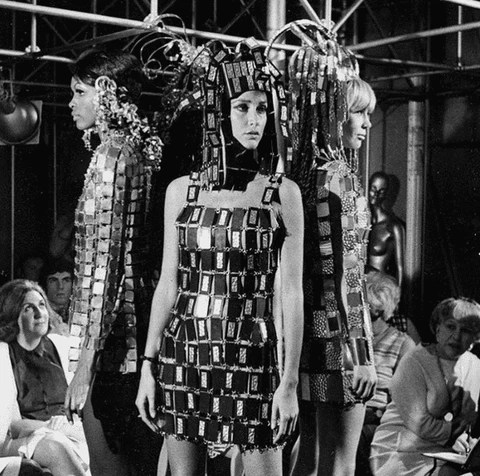
But there was still one problem: their clothes didn’t match their furniture. This is where the space-age designers of fashion come into play. Designers like Pierre Cardin, Paco Rabanne, André Courrèges, Reed Crawford, and later, Theirry Mugler began to make the clothes of the future that reflected the same feeling as the furniture designers. Space-age fashion was full of metallics, mimicking space suits, the same sterile whites that matched the furniture, and multiple bright colors. They featured a much more technical, “futuristic” take on the mod style, which was popular at the time. With science fiction books, space-age furniture, and space-age fashion, people could finally “escape” their bleak reality and pretend to live their egalitarian space fantasies.
Unfortunately, in 2023 escapism in fashion is not nearly as cool. Instead of futuristic garments inspired by spaceships and science fiction books, we have the Fortnite and Balenciaga collaboration and metaverse-based cyber-fashion. Today, the new frontier isn’t the cosmos like in the 60s, instead, it’s the metaverse and virtual spaces. Every year the amount of time spent playing video games and using social media increases. With the pandemic, people’s interactions were limited to purely non-physical spaces like Zoom, FaceTime, Social Media, Video Games, or Virtual Reality or Augmented Reality communities. Although these VR worlds existed before, 2019 to 2020 saw an increase of 18 million users for these VR or AR worlds. Besides offering these users a way to “hang out” virtually when they can’t physically be together, people find that they can express and accept themselves better in virtual worlds. University College of London study published in PLOS ONE found virtual reality as a viable way to treat people’s self-critical thoughts and behaviors. Members of these VR communities claim that they feel more comfortable expressing themselves, and it helps them improve their mood, though there is no clinical data proving this: Most suggest the opposite.
Once again, these feelings of technological escapism transcend entertainment and permeate the fashion industry. In the past few years, the blending of tech and fashion has become very popular. As people increasingly feel the need to escape reality, living more and more of their lives online, and look for ways to express themselves in virtual communities, brands have figured out they can enter these virtual worlds and sell digital garments through collaborations like Lacoste x Minecraft, Balenciaga x Fortnite, Gucci x Roblox, or H&M x Animal Crossing, or through the recent AI Fashion Week, which showcased emerging AI designers—whatever that means.
The biggest brand adoption of Web 3 has been Nike’s “.Swoosh” project. After the company’s 2021 purchase of RTFK, an NFT startup, Nike announced they were working on a Web 3 project to offer virtual garments that would act as NFTs through their “.Swoosh” marketplace. This zeitgeist can also be seen premating the mainstream physical (real) fashion world. Moncler’s Palm Angels “Maya” light-up puffer, and the rise of wearable technology shows the literal side of the merging. Aesthetically this trend can be seen as well, whether it’s with the popularity of designers with highly-technical, metallic heavy, angular designs like Iris van Herpen, Kiko Kostadinov, or Rick Owens, or micro trends like the “Cyber-Core” aesthetic of black contrasted by neons, or metallics, and tech-inspired garments. Interestingly, the brand that has expressed this feeling the best recently is Courrèges, started by Space-Age fashion designer André Courrèges. It was revived in 2015, and Nicolas di Felice is the currently creative director.
Now it would be easy to say that these trends were both just examples of retail therapy as an escape rather than an imaginary escape through design. But as I’ve shown in all my previous papers, fashion trends can be used as a way to visualize someone’s unconscious thoughts, fears—and in this case—desires. By choosing these futuristic, space-inspired designs, people show their conscious or unconscious desires for escape, whether that be escape to space or escape to the metaverse.
Work Cited
Burton, Kristen. “Cold Conflict: The National WWII Museum: New Orleans.” The National WWII Museum | New Orleans, 31 July 2020, http://www.nationalww2museum.org/war/articles/cold-conflict.
Chopra, Jaskiran. “Teens Say Social Media Give Valuable Source of Self-Expression.” The Pioneer, 2019, http://www.dailypioneer.com/2019/state-editions/teens-say-social-media-give-valuable-source-of-self-expression.html.
Collins, Jane. “Women’s Footwear, Accessories Jewellery Forecast A/W 23/24: NatureVerse.” WGSN, 6 Mar. 2022, http://www.wgsn.com/fashion/article/93126.
Correa, Ana. “Design Capsule: Women’s Footwear & Accessories Space Sahara A/W 23/24.” WGSN, 19 Aug. 2022, http://www.wgsn.com/fashion/article/94329.
Denson, Anna. “Pinterest Predicts Cyber Chic Will Be All the Rage in 2023 Fashion.” Glam, 22 Dec. 2022, http://www.glam.com/1146725/pinterest-predicts-cyber-chic-will-be-all-the-rage-in-2023-fashion/.
“Design Details: Digitized.” DONEGER, Mar. 2021, http://www.donegertobe.com/creative-direction/design-details-digitized.
“Digitized Design Deepens.” DONEGER, 23 Mar. 2022, http://www.donegertobe.com/great-ideas/digitized-design-deepens.
“Digitized.” DONEGER, Dec. 2020, http://www.donegertobe.com/creative-direction/design-movements-digitized.
Dolan, Leah. “A Visual History of Space-Age Fashion.” CNN, 23 May 2021, http://www.cnn.com/style/article/space-age-fashion-scn/index.html.
Falconer, Caroline J., et al. “Embodying Compassion: A Virtual Reality Paradigm for Overcoming Excessive Self-Criticism.” PLOS ONE, 12 Nov. 2014, journals.plos.org/plosone/article?id=10.1371%2Fjournal.pone.0111933.
Freeman, Guo, and Divine Maloney. Body, Avatar, and Me: The Presentation and Perception of Self in Social Virtual Reality, Dec. 2020.
Hayward, Andrew. “Nike Launches .Swoosh WEB3 Platform, with Polygon Nfts Due in 2023.” Decrypt, 14 Nov. 2022, decrypt.co/114494/nike-swoosh-web3-platform-polygon-nfts.
“Metaverse Materialized.” DONEGER, 15 Dec. 2021, http://www.donegertobe.com/great-ideas/metaverse-materialized.
Paek, MAx. “What Is Space Age Furniture? A History of the Design Style.” ONE37pm, 8 June 2022, http://www.one37pm.com/style/what-is-space-age-furniture.
Pruitt, Sarah. “How ‘duck-and-Cover’ Drills Channeled America’s Cold War Anxiety.” History.Com, 26 Mar. 2019, http://www.history.com/news/duck-cover-drills-cold-war-arms-race.
 Cameron Noble Irish
Leave a comment